China's Shenzhou-24 Mission: Pakistan's First Astronaut Reaches Tiangong Space Station
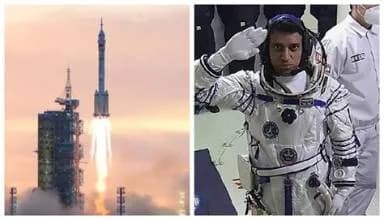
China's Shenzhou-24 mission launches Pakistan's first astronaut, Muhammad Zeeshan Ali, to the Tiangong space station
China has achieved another significant milestone in space exploration with the successful launch of its Shenzhou-24 crewed space mission, carrying Pakistan's first astronaut to the Tiangong space station. The mission marks an important development in international space cooperation and highlights the growing partnership between China and Pakistan. Muhammad Zeeshan Ali, a former fighter pilot, has become the first foreign astronaut to participate in a Chinese crewed space mission, making the launch a historic moment for both countries.
China's Shenzhou-24 Mission Successfully Launches
China launched its Shenzhou-24 spacecraft from the Jiuquan Satellite Launch Center in the Gobi Desert on Wednesday, 25 November 2026. The spacecraft carried three astronauts, including Pakistani astronaut Muhammad Zeeshan Ali, alongside Chinese astronauts Tang Hongbo and Wu Yi. The rocket lifted off at 08:18 local time, and the launch was declared a complete success shortly afterwards.
The mission represents an important step in China's expanding space programme, particularly its efforts to strengthen international participation in human spaceflight. China's Tiangong space station has become a major platform for scientific research and technological development, supporting experiments in several areas of space science.
Muhammad Zeeshan Ali Becomes Pakistan's First Astronaut in China's Space Mission
One of the most significant aspects of the Shenzhou-24 mission is the participation of Muhammad Zeeshan Ali, who has made history as the first Pakistani astronaut to join a Chinese crewed spaceflight. A former fighter pilot, Ali represents a major achievement for Pakistan's growing ambitions in space exploration.
Before the launch, Ali expressed his sense of responsibility towards his country and its people. His participation is expected to strengthen Pakistan's position in international space research while opening new opportunities for future scientific and technological cooperation.
Ali will remain aboard the Tiangong space station for a relatively short period before returning to Earth with two Chinese astronauts who have been stationed there since May 2026.
China and Pakistan Strengthen Their Space Cooperation
The Shenzhou-24 mission also carries considerable diplomatic importance. China and Pakistan are marking 75 years of cooperation in space-related activities, making the astronaut's participation a symbolic achievement in their longstanding bilateral relationship.
Both countries have expressed interest in expanding collaboration in science, technology and space research. By including a Pakistani astronaut in its crewed mission, China is demonstrating its willingness to develop international partnerships through its space programme.
For Pakistan, the mission provides an opportunity to gain valuable experience in human spaceflight and scientific research. It could also encourage further investment in the country's space sector and inspire future generations to pursue careers in science, engineering and astronomy.
Scientific Experiments Aboard the Tiangong Space Station
Apart from its diplomatic significance, the Shenzhou-24 mission will contribute to important scientific research. The astronauts are expected to conduct experiments involving aerospace medicine, combustion, biological systems and the effects of the space environment on living organisms.
Muhammad Zeeshan Ali will participate in research examining photosynthesis in bacteria and the effects of radiation and microgravity on seeds. These experiments could help scientists better understand how biological organisms respond to conditions beyond Earth.
Researchers will also investigate how space conditions influence ageing and human health. Such studies could contribute to developing better approaches to preventing and treating age-related vascular diseases. Understanding how the human body adapts to prolonged exposure to microgravity is particularly important as countries prepare for longer space missions.
China's Tiangong Space Station and Its Growing Global Importance
China's Tiangong space station is a central component of its long-term space exploration strategy. Developed as an independent orbital research facility, the station supports scientific experiments, technological demonstrations and international cooperation.
China has invested billions of dollars in developing its space programme and maintaining the Tiangong station. Its astronaut crews generally operate on rotating six-month missions, allowing researchers to conduct continuous scientific experiments while maintaining the station's operations.
The participation of international astronauts in Chinese missions could further increase the station's importance in global space research. It also reflects the growing competition and cooperation among countries seeking to expand their presence beyond Earth.
What the Shenzhou-24 Mission Means for the Future of Space Exploration
The successful launch of Shenzhou-24 represents more than another achievement in China's space programme. It demonstrates how international partnerships are becoming increasingly important in modern space exploration. Pakistan's participation could encourage other countries to explore opportunities for cooperation with China in astronaut training, scientific research and space technology.
As space exploration becomes more advanced, countries are increasingly looking beyond national achievements towards shared scientific objectives. Research conducted aboard the Tiangong space station could contribute to developments in medicine, agriculture, biotechnology and our understanding of human life in space.
The Shenzhou-24 mission therefore represents a significant milestone for China and Pakistan. With its combination of scientific research, international cooperation and historic astronaut participation, the mission could help shape the next chapter of global space exploration.
Source: https://www.bbc.com/news/articles
Follow: https://globalbizinsider.com/