Huawei Trade Secrets Case: US Jury Finds Company Guilty
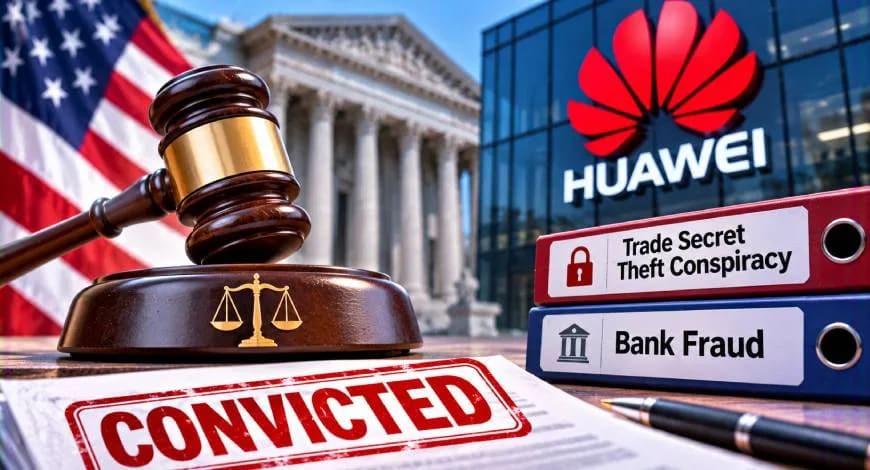
The Huawei trade secrets case ends with the company guilty of trade secret theft and bank fraud but acquitted of racketeering in a US court.
The Huawei trade secrets case has resulted in a major legal setback for the Chinese telecommunications giant, with a US jury finding the company guilty of conspiracy to steal trade secrets, bank fraud and other criminal offences. However, the jury rejected the more serious racketeering conspiracy charge, marking a mixed outcome in a closely watched federal trial in Brooklyn, New York.
The verdict follows a two-month trial in which US prosecutors accused Huawei Technologies and three of its subsidiaries of engaging in unlawful business practices to strengthen their competitive position in the global telecommunications and technology markets. Prosecutors alleged that the company used deception, financial misconduct and the theft of confidential technology information to expand its business operations.
According to the jury's decision, Huawei was found guilty on 10 of the 12 counts brought against it. These included conspiracy to violate US sanctions and other offences connected to financial fraud and trade secret theft. However, jurors declined to convict the company of racketeering conspiracy, a charge that would have required them to conclude that Huawei operated as a criminal enterprise.
US Prosecutors Accused Huawei of Trade Secret Theft and Fraud
During the trial, federal prosecutors argued that Huawei had spent years using questionable business practices to gain an advantage over competitors. They alleged that the company stole proprietary technology from rival businesses and misrepresented certain business dealings to financial institutions.
Assistant US Attorney Meredith Arfa told jurors during closing arguments that Huawei had pursued aggressive expansion strategies over approximately two decades, allegedly involving deception and the unauthorised use of competitors' technology.
US Attorney General Todd Blanche also described the verdict as an important step towards accountability. He stated that Huawei and its subsidiaries had conducted business in the United States through alleged practices involving lies and theft.
The prosecution's case focused on allegations that Huawei used confidential information belonging to other technology companies and concealed aspects of its business activities, including dealings connected to Iran, from financial institutions.
Huawei Welcomes Racketeering Acquittal
Huawei responded to the verdict by highlighting the jury's decision to reject the racketeering charge. In its official statement, the company said the acquittal confirmed that the allegations lacked a factual basis. It also stated that it would take all necessary legal steps to defend its rights and interests.
The company's defence team argued throughout the proceedings that prosecutors had approached the case with the assumption that Huawei was a criminal organisation. According to the defence, the company's international growth was the result of innovation, investment and hard work rather than criminal activity.
Defence attorney Brian Heberlig said Huawei was pleased that the jury rejected the racketeering conspiracy allegation. He described the charge under the Racketeer Influenced and Corrupt Organizations Act, commonly known as RICO, as a significant overreach by prosecutors.
However, the defence acknowledged that the remaining guilty verdicts represented a mixed outcome for the company. Heberlig maintained that Huawei believed it deserved acquittals on all charges.
Background: Huawei's Long-Running Legal Battle With the United States
The latest verdict is part of a wider legal dispute between Huawei and US authorities that began several years ago. Federal prosecutors first announced criminal charges against the company in 2019.
The case gained international attention following the December 2018 arrest of Huawei executive Meng Wanzhou in Canada. Meng, also known as Cathy Meng, was detained for approximately three years while facing extradition proceedings connected to allegations brought by US authorities.
She was eventually allowed to return to China in 2021 following an agreement with US prosecutors.
The dispute also reflects broader tensions between Washington and Beijing over technology competition, national security, trade restrictions and the global telecommunications industry. Huawei has remained a major subject of scrutiny in US policy discussions concerning Chinese technology companies and access to sensitive infrastructure markets.
China Criticises US Actions Against Chinese Technology Companies
The Chinese government criticised the US prosecution, describing Washington's actions as an attempt to suppress Chinese companies. Beijing reiterated its support for Chinese businesses seeking to protect their legitimate interests.
The case highlights the continuing challenges faced by Chinese technology companies operating in international markets, particularly amid growing tensions between the world's two largest economies.
Huawei has built a significant international presence, with operations in approximately 170 countries and a workforce exceeding 200,000 employees, according to arguments presented by its defence team during the trial.
Despite the legal challenges, the company has maintained that its business expansion has been driven by technological development and commercial competition.
Huawei Faces Sentencing in September 2027
The legal proceedings are not yet over. Sentencing for Huawei is scheduled for September 2027, giving the company and its legal team additional time to prepare their arguments.
Heberlig indicated that the defence would make significant efforts to secure the lowest possible sentence. He also expressed confidence that Huawei would pursue an appeal after sentencing.
The company is expected to challenge aspects of the verdict through the US judicial system, potentially extending the legal battle further.
What the Verdict Means for Huawei and the Global Technology Industry
The outcome of the Huawei trade secrets case carries wider implications for the global technology industry. The guilty findings could increase legal and regulatory pressure on the company while reinforcing concerns about intellectual property protection, corporate compliance and international business practices.
For technology companies operating across multiple countries, the case also highlights the importance of protecting proprietary information, maintaining transparent financial relationships and complying with international sanctions.
Although Huawei avoided the broader racketeering conviction, the guilty verdicts on 10 counts represent a significant development in its long-running legal dispute with the United States.
The upcoming sentencing and expected appeals will determine the next stage of the case, keeping Huawei's legal position and its relationship with US authorities under international scrutiny.
Source : https://www.bbc.com/news/articles/cmy49ngydqzpo
Follow The Global Biz Insider for more such News .