Serbia Student-Led Movement Demands Sweeping Resignations
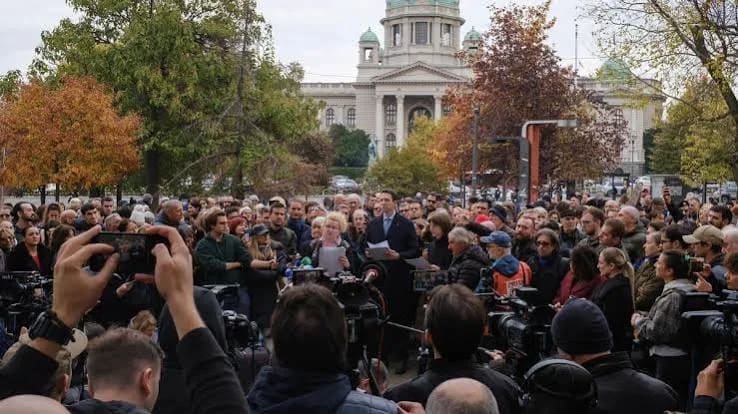
Serbia student-led movement demands sweeping resignations of police, intelligence and judiciary officials after defeating Aleksandar Vučić's ruling party.
The Serbia student-led movement has demanded sweeping resignations across the country's police, intelligence and judiciary following its historic election victory over the ruling political establishment associated with former president Aleksandar Vučić. The movement's newly elected lawmakers are calling for major institutional changes, accusing sections of the state system of failing to uphold the law and protect public interests.
The announcement marks the beginning of what could become a significant political transformation in Serbia, with the incoming administration promising to tackle corruption, strengthen democratic institutions and restore public confidence in government.
Student-Led Movement Targets Police and Intelligence Leadership
During its first press conference at Pioneers' Park in Belgrade, opposite Serbia's parliament, representatives of the Student List movement demanded the immediate dismissal of police officers accused of breaking the law.
The demands specifically included senior officials leading the national police, the BIA security agency and the anti-terrorism unit.
The movement said concerns had emerged about the possibility of evidence linked to alleged wrongdoing being destroyed during the transition of power.
Although the election has delivered a significant political setback to Vučić's camp, the transfer of authority is expected to take several weeks. The incoming lawmakers want accountability measures to begin without delay.
Protests Following Fatal Railway Station Collapse
The student movement emerged from widespread protests following the deadly collapse of a railway station canopy in Novi Sad in November 2024, which killed 16 people.
The incident triggered public anger over alleged corruption, construction oversight and government accountability.
Students and demonstrators demanded investigations into the tragedy and action against those responsible. Over time, the protests developed into a broader political movement calling for institutional reform and changes to Serbia's political leadership.
The movement's election victory represents a major development for a campaign that initially focused on accountability following the railway disaster.
New Lawmakers Promise Anti-Corruption Reforms
The Student List movement has outlined an ambitious programme known as the Student Plan, promising to tackle corruption, recover public funds and increase investment in education and the economy.
The plan also includes reforms aimed at improving transparency, strengthening public institutions and protecting media independence.
One of the movement's early targets is Serbia's state broadcaster, RTS. Its director, Manja Grčić, has already stepped down following the election result.
Newly elected MP Mirjana Nikolić argued that Serbian citizens deserve truthful and independent information, claiming that the broadcaster had served government interests for years.
The movement has also called for changes in the leadership of telecommunications company Telekom Srbija, currently headed by Vladimir Lučić.
Former Central Bank Governor Calls for Reforms Within Six Months
Dejan Šoškić, a former governor of the National Bank of Serbia who is among the successful candidates on the Student List, believes the new administration must move quickly.
He has called for significant improvements within the first six months, including media freedom, stronger anti-corruption measures, properly functioning public institutions and the introduction of a lustration law.
Lustration would involve restricting individuals found responsible for violating citizens' rights from holding public office.
However, implementing these measures could prove difficult because the previous ruling establishment has maintained influence across Serbia's major institutions for years.
Political analysts have also warned that the incoming administration will need to work with parts of the existing system that have continued to function effectively.
Acting President Accuses Winners of Revolutionary Justice
Serbia's political transition is already generating controversy.
Acting President Ana Brnabić has criticised the election winners, accusing them of pursuing what she described as revolutionary justice rather than respecting the rule of law.
She has also raised concerns that the incoming political leadership could attempt to shut down media organisations that do not support its agenda.
The disagreement highlights the challenges facing the student-backed movement as it attempts to introduce institutional changes while maintaining democratic principles and legal protections.
141 Candidates Selected Through a Student-Led Process
A distinctive feature of the Student List movement is the process through which its parliamentary candidates were selected.
All 141 successful candidates were chosen by students from universities across Serbia through a lengthy and confidential selection process.
The group includes academics, professors, artists, athletes, intellectuals and medical professionals, including as many as 12 doctors and surgeons.
The movement does not have an obvious single political leader. Instead, its newly elected representatives are expected to follow a detailed 1,200-page programme developed through months of discussions among students.
University of Belgrade professor Radomir Saičić has said the new lawmakers intend to work closely with the students who selected them and follow the movement's political programme.
Serbia Faces a Difficult Foreign Policy Balancing Act
Beyond domestic reforms, the incoming government will also face important foreign policy decisions.
Serbia is an official candidate for European Union membership but maintains close diplomatic and economic relations with Russia and China.
Belgrade has traditionally balanced its relationship with Western governments against its eastern partners. Unlike most European countries, Serbia has not imposed sanctions on Moscow following Russia's full-scale invasion of Ukraine in 2022.
Relations with Russia have also been supported by energy cooperation and preferential gas arrangements.
The European Union has welcomed the election outcome and expressed support for reforms involving the rule of law, media freedom and anti-corruption efforts.
However, EU integration has received relatively limited attention in the Student List's election manifesto, which describes the bloc primarily as Serbia's most important economic partner.
Former central bank governor Dejan Šoškić has also indicated that changing Serbia's existing approach to international sanctions may not be an immediate priority.
Presidential Elections Could Shape Serbia's Political Future
Despite the historic parliamentary victory, the student-backed movement faces another major political challenge.
Serbia's presidential elections are scheduled for December, creating a relatively short window for the incoming administration to demonstrate progress on its promises.
Aleksandar Vučić is legally barred from seeking a third presidential term. However, he has indicated that his defeated Serbian Progressive Party intends to rebuild its political position and challenge the new leadership.
The coming months will therefore be critical in determining whether the student-led movement can translate its electoral success into lasting institutional and political reforms.
For Serbia, the transition represents more than a change in parliamentary leadership. It is a major test of whether a movement born out of public protests can deliver meaningful changes to governance, accountability and democratic institutions.
Source :https://www.bbc.com/news/articles/cmx2dwzp0z0vo
Follow The Global Biz Insider For More Such News .