Spain General Strike Triggers Nationwide Disruption
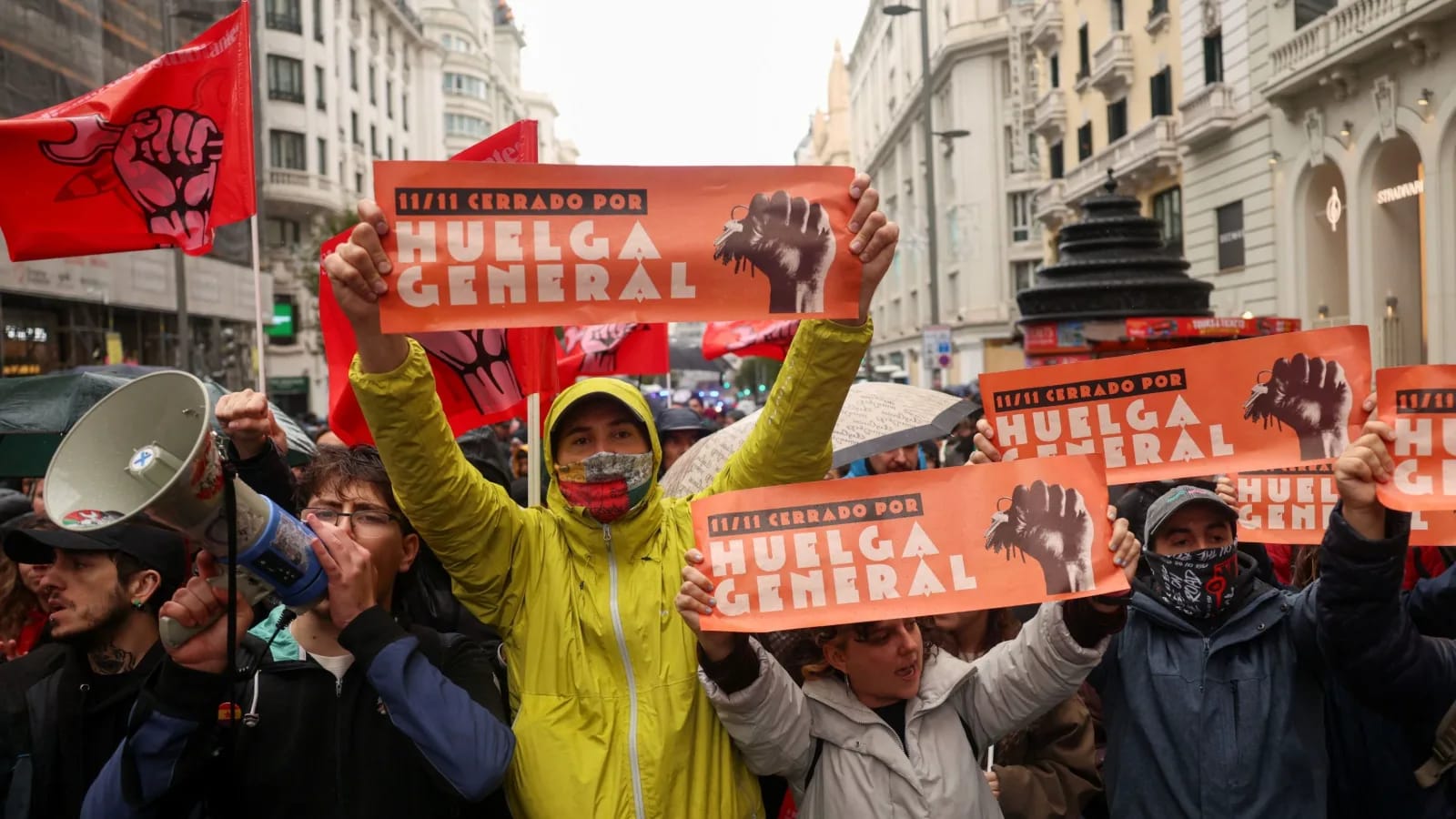
Spain general strike disrupts transport, schools, factories and businesses as workers protest rising housing costs, low wages and living conditions.
Spain experienced widespread disruption as workers joined the country's first nationwide general strike in 14 years, affecting transportation networks, industrial operations, educational institutions and several essential services. The Spain general strike reflected growing public frustration over the rising cost of living, housing affordability, wages and working conditions.
The nationwide mobilisation brought together trade unions, workers, housing campaigners and other organisations seeking stronger government action on economic and social challenges. Demonstrations took place across several major cities, including Madrid and Barcelona, while industrial facilities, transport services and commercial operations experienced interruptions.
The strike represented a significant moment for Spain's labour movement, highlighting the increasing connection between workers' economic concerns and the country's wider housing crisis. Protesters argued that ordinary employees are finding it increasingly difficult to maintain a reasonable standard of living as rental prices and everyday expenses continue to place pressure on household budgets.
The scale of the demonstrations also attracted political attention, particularly as housing affordability and economic inequality have become important subjects in Spain's national debate.
Housing Affordability Emerges as the Central Issue
One of the main reasons behind the Spain general strike was the growing difficulty of finding affordable housing. Workers and housing campaigners have raised concerns about the widening gap between household incomes and the cost of renting or purchasing property.
In cities such as Madrid and Barcelona, rising rental prices have placed considerable pressure on younger workers, students, families and people employed in lower-income occupations. Many residents argue that a growing proportion of their monthly earnings is being spent on accommodation, leaving less money for food, transportation, healthcare and other essential expenses.
Housing campaigners have also criticised the growing influence of property speculation and investment activity in the residential market. They argue that housing should primarily serve as a basic necessity rather than becoming an asset accessible mainly to wealthier individuals and investors.
Trade unions and protest organisers have therefore called for stronger tenant protections, more affordable rental options and policies designed to improve access to housing. The issue has become particularly important for younger generations, many of whom face difficulties moving out of their family homes or establishing financial independence because of high accommodation costs.
Trade Unions Mobilise Workers Across Spain
The nationwide strike received support from major Spanish trade union organisations, including the Workers' Commissions (CCOO) and the General Union of Workers (UGT). Other labour groups, housing organisations and civil society campaigners also participated in the mobilisation.
Union representatives argued that workers should not have to choose between paying rent and meeting other basic household expenses. They called for improvements in working conditions, stronger social protections and government measures that address the growing affordability crisis. The participation of different groups demonstrated how housing concerns have expanded beyond traditional tenant organisations to become a wider economic issue involving employees, families and younger residents.
Trade union leaders also sought to highlight the relationship between wages and living costs. They argued that employment alone does not necessarily guarantee financial security when housing, transportation and other essential expenses continue to increase.
The mobilisation consequently brought together several demands under a broader call for improved living standards and greater economic protection.
Public Transportation Faces Severe Disruptions
Transportation was among the sectors most heavily affected by the nationwide walkout. Public transport services in several cities operated with reduced schedules, while roadblocks and picket lines created additional difficulties for commuters and businesses.
Barcelona experienced particularly significant disruption during the morning rush hour. Metro, railway and bus services faced interruptions, with some transport operations coming close to a standstill. Passengers encountered delays, cancellations and difficulties accessing major stations.
In Madrid, city buses were among the services affected by the strike, while heavy rainfall added further complications for commuters. Transport workers and demonstrators gathered around important transport facilities, affecting normal movement across parts of the capital.
Air travel was also affected. According to reports published during the strike, 263 of the 4,529 scheduled flights had been cancelled by midday. The cancellations created uncertainty for passengers and airlines, particularly those travelling between major Spanish cities and international destinations.
The disruption demonstrated how a nationwide labour movement can affect interconnected transport systems and create challenges for commuters, tourists, logistics companies and commercial operators.
Schools, Universities and Public Services Affected
Educational institutions across Spain also experienced interruptions as teachers, administrative employees and other education-sector workers participated in the strike.
Several schools and universities either remained closed or operated with significantly reduced staff. Students and parents faced uncertainty over classes, examinations and other scheduled academic activities.
In Madrid, the general strike coincided with an existing teachers' labour action that had already been continuing for nearly a month. Educators have been raising concerns about working conditions and employment-related issues, adding another dimension to the disruption.
Public services were also affected, although the level of participation differed between sectors and regions. Healthcare and social services generally recorded lower participation than heavily unionised industrial sectors. Minimum-service arrangements helped maintain some essential operations.
The varying levels of participation demonstrated that the strike did not affect every sector equally. While some industries experienced substantial stoppages, others continued operating with reduced disruption.
Industrial Production and Businesses Experience Slowdown
Industrial facilities, manufacturing companies and commercial establishments experienced interruptions as employees joined the nationwide protest.
According to figures released by the trade unions, participation was particularly strong in several strategic industries. Union representatives reported approximately 90% participation in the automotive and port sectors, 85% in the meat industry, 82% in waste collection and 75% in the energy sector.
These figures were reported by the unions and were not universally accepted by business organisations. Employers and opposition representatives disputed the overall scale of participation, highlighting differences between regions and industries.
Factories faced reduced staffing levels, while some production activities were suspended or operated at limited capacity. Ports and logistics facilities also experienced disruption, raising concerns about the movement of goods and the potential impact on supply chains.
For businesses, the strike created operational challenges involving employee availability, transportation, deliveries and customer services. Small businesses were particularly exposed to disruptions because even temporary interruptions can affect daily revenue and business operations.
The industrial impact also highlighted the importance of labour stability for Spain's wider economy. A prolonged disruption to manufacturing, logistics and essential services could create additional costs for companies and consumers.
Protests Turn Tense in Madrid and Barcelona
Although the general strike was primarily organised around economic and social demands, some demonstrations resulted in confrontations between protesters and police.
In Madrid, tensions increased near Mercamadrid, the country's main wholesale market for fresh produce. Picketing workers gathered outside the facility, where clashes occurred after police intervened. Reports indicated that pepper spray was used during the incidents, although police accounts differed on the circumstances. Several people required medical attention, and arrests were reported.
Barcelona also witnessed roadblocks, including some involving burning tyres. Demonstrators blocked roads and disrupted traffic as part of their efforts to increase pressure on employers and policymakers.
Authorities reported arrests linked to minor incidents across the country. Despite these confrontations, demonstrations continued in several cities, with workers and housing activists participating in organised marches and gatherings.
The protests attracted significant public attention because they connected everyday economic difficulties with broader questions about government responsibility, housing policy and workers' rights.
Rising Rents and Housing Shortages Intensify Public Anger
Spain's housing crisis has become one of the most significant concerns behind the nationwide mobilisation. Over the past decade, rental prices have increased considerably, placing pressure on households and making affordable accommodation difficult to secure.
According to reporting by The Guardian, rents have increased by around 80% over a decade, while housing prices have risen by approximately 63%. The rising cost of accommodation has affected major urban centres, particularly areas experiencing strong demand from tourism, investment and population growth.
Madrid and Barcelona have become important centres of the housing debate. Many residents argue that the expansion of short-term rentals and property investment has reduced the availability of affordable long-term accommodation.
Young professionals, students and lower-income households have been particularly affected. For many workers, finding accommodation close to their workplaces has become increasingly difficult because rental expenses consume a substantial share of their monthly income.
The problem has also affected people who want to purchase their first homes. Higher property prices, mortgage expenses and limited housing availability have made homeownership increasingly difficult for younger generations.
Housing organisations are demanding stronger regulation of the rental market, restrictions on certain eviction practices, measures against speculative property activity and greater investment in affordable housing.
The eviction of 87-year-old Maricarmen Abascal from her Madrid home in September, followed by her death, became an important symbol of the country's housing concerns. Her case intensified public debate about vulnerable tenants and the consequences of housing insecurity.
Political Tensions Increase Ahead of November 29 Election
The Spain general strike has also become an important political development because it is taking place less than three weeks before the country's November 29 national election.
Prime Minister Pedro Sánchez and his Socialist-led government are facing increasing pressure over housing affordability, economic conditions and other political challenges. The housing crisis has become a major issue in the election campaign, with voters demanding more effective measures to control rental costs and improve access to accommodation.
Sánchez's government has attempted to place social and economic concerns at the centre of the political discussion. The prime minister has publicly recognised the historical contribution of labour movements to improvements in workers' rights, including the eight-hour working day and the development of public healthcare.
However, the opposition has criticised the timing of the strike. The conservative People's Party (PP) and the far-right Vox party have questioned the political motivations behind the mobilisation, arguing that trade unions are using the protest to influence the upcoming election.
The opposition has also raised concerns about the potential economic consequences of the nationwide disruption.
The political debate has become more complicated because the government is also facing scrutiny over corruption allegations involving individuals close to its political circle and questions about infrastructure investment following a deadly high-speed train accident.
For Sánchez, the strike provides an opportunity to bring housing and workers' rights back into the national political discussion. However, the mobilisation also demonstrates that public frustration extends beyond the opposition's political criticism and includes demands for stronger action from the central government itself.
Why Is This General Strike Significant?
The latest mobilisation is significant because it is Spain's first general strike in 14 years. The previous nationwide general strike took place in 2012, when workers protested against austerity measures introduced during the eurozone debt crisis.
The 2026 strike has a different central focus, with housing affordability, wages and rising living costs taking priority.
It also demonstrates how economic concerns can bring together groups that traditionally organise around different issues. Trade unions, tenants' associations, industrial employees, teachers and housing campaigners have joined forces around the demand for better living conditions.
The mobilisation highlights several wider challenges facing Spain:
- Housing affordability: Rising rents and property prices are making accommodation increasingly difficult to access.
- Wage pressures: Workers want salaries that better reflect everyday living expenses.
- Employment conditions: Trade unions are demanding stronger protections and improvements in workplace conditions.
- Economic inequality: Households are concerned about the growing gap between incomes and essential expenses.
- Government accountability: Protesters want policymakers to take more effective action on housing and social protection.
The strike has also attracted international attention because Spain is one of Europe's major economies. Disruptions to its transport, manufacturing and logistics sectors can affect businesses, workers and commercial activities beyond the country's borders.
What Happens Next for Spain?
The immediate impact of the general strike will depend on how quickly transportation, industrial operations, educational institutions and other public services return to normal.
However, the wider concerns behind the protest are unlikely to disappear immediately. Housing affordability, rising rents and the relationship between wages and living costs remain significant challenges for Spanish households.
Trade unions and housing organisations are expected to continue pressing the government for stronger policies, including greater protection for tenants, improved access to affordable accommodation and measures to address property speculation.
The November 29 election could become an important turning point in determining how Spain approaches these issues. Political parties will face increasing pressure to present practical solutions that address the concerns of workers, renters and younger generations.
For businesses, the strike serves as a reminder of the economic consequences of unresolved labour and social challenges. Transportation interruptions, production delays and reduced commercial activity can create financial pressure across multiple industries.
Ultimately, the Spain general strike represents more than a temporary interruption to the country's economic activities. It reflects growing public frustration over the cost of living and housing affordability, while placing additional pressure on political leaders to respond to demands for meaningful economic and social reforms.
Source : https://www.bbc.com/news/articles/cwvg25nypmrvo
Follow The Global Biz Insider For More Such News .