UK and EU Brexit Reset Deal 2026: New Trade, Travel and Economic Agreements
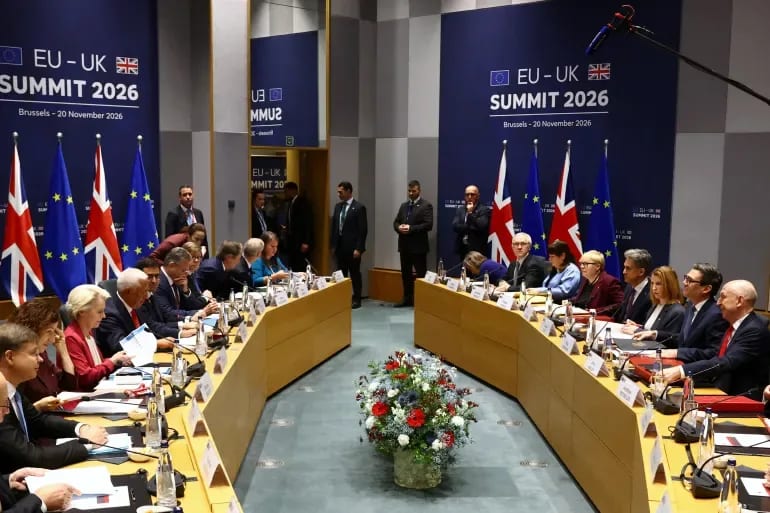
The UK and EU have reached a historic Brexit reset agreement in November 2026, focusing on trade, youth mobility, carbon markets
The United Kingdom and the European Union have reached a significant agreement to rebuild their relationship nearly a decade after the Brexit referendum. The breakthrough came during the UK-EU summit held in Brussels on November 20, 2026, where both sides agreed on a series of measures aimed at reducing trade barriers, improving economic cooperation and creating new opportunities for young people. The agreement represents an important step towards repairing relations that have remained complicated since Britain formally left the European Union in 2020.
The latest UK-EU Brexit reset deal 2026 reflects growing recognition on both sides that closer cooperation could deliver economic and social benefits. British Prime Minister Andy Burnham described the agreement as an important moment for Britain and Europe, highlighting the need to move beyond years of political disagreements and economic uncertainty. European Commission President Ursula von der Leyen also welcomed the progress, describing the agreement as a turning point in relations between the two sides.
UK-EU Summit 2026: What Does the New Agreement Include?
The Brussels summit focused on three major areas of cooperation: food and agricultural trade, youth mobility and emissions trading systems. These agreements are designed to address some of the practical difficulties that emerged following Brexit. Although Britain remains outside the European Union, the new arrangements could make economic cooperation easier and create stronger connections between the two economies.
One of the most important developments involves reducing border checks and administrative requirements for animal and plant products. Businesses involved in exporting agricultural goods have faced additional paperwork, certification requirements and inspection procedures since Brexit. The proposed sanitary and phytosanitary agreement aims to simplify these processes, potentially reducing costs for exporters and making cross-border trade more efficient.
The agreement could also benefit consumers by reducing unnecessary supply-chain expenses. Lower administrative costs may help businesses operate more efficiently and could eventually ease some price pressures on food products. However, the actual impact will depend on implementation and how quickly businesses can benefit from the new arrangements.
Youth Mobility Scheme to Create New Opportunities
Another major feature of the UK-EU agreement is the proposed youth mobility scheme. Under the arrangement, up to 100,000 young people from each side could receive opportunities to live, work and study in the other region for a limited period of up to three years.
The initiative is particularly important for younger generations who have experienced restricted opportunities for international mobility following Brexit. Before Britain's departure from the European Union, young British and European citizens benefited from greater freedom to travel, study and work across member countries.
The new scheme aims to restore some of these opportunities without reversing Britain's decision to leave the European Union. It could help young people gain international work experience, develop professional skills, explore educational opportunities and experience different cultures.
For universities, employers and educational institutions, the arrangement could also encourage greater international cooperation. However, the scheme is expected to require further implementation work, with the first participants potentially benefiting from 2030.
Carbon Markets and Climate Cooperation
Climate policy is another important component of the new agreement. Britain and the European Union have agreed to link their emissions trading systems, creating a framework for closer cooperation on carbon pricing.
Emissions trading systems are designed to encourage companies to reduce greenhouse gas emissions by placing a financial cost on pollution. Linking the UK and EU systems could reduce regulatory differences and simplify certain aspects of cross-border trade.
The agreement could also help businesses operating in carbon-intensive industries, including steel and manufacturing, by reducing the risk of facing overlapping carbon-related charges. Stronger coordination may encourage investment in cleaner technologies while supporting the transition towards more sustainable industrial practices.
This development demonstrates that environmental cooperation remains an important area of shared interest despite the political differences created by Brexit.
Economic Impact of the UK-EU Brexit Reset Deal
The economic implications of the agreement could be significant for Britain. Prime Minister Andy Burnham stated that the new arrangements could contribute approximately 0.5% to the UK's gross domestic product, representing an estimated £17 billion boost to the British economy.
Reducing trade barriers could improve business confidence, encourage investment and strengthen supply chains. British exporters may benefit from easier access to European markets, while European companies could experience fewer administrative obstacles when trading with the United Kingdom.
The agreement also comes at a time when European economies are dealing with international competition, energy costs, geopolitical uncertainty and changing global trade relationships. Stronger UK-EU cooperation could help both sides respond more effectively to these challenges.
Nevertheless, the projected economic benefits will depend on how effectively the agreements are implemented and whether businesses experience meaningful reductions in costs.
University Tuition Fees Remain an Unresolved Issue
Despite the progress made during the summit, several important disagreements remain. One major issue concerns university tuition fees for European students studying in British universities and British students attending institutions across the European Union.
European representatives have pushed for EU students to receive more favourable tuition arrangements, potentially allowing them to pay the same fees as domestic students in Britain. However, the UK government has favoured offering reduced fees rather than fully restoring the previous arrangements.
Both sides have agreed to continue discussions, with the aim of reaching a decision within six months. Resolving this issue could become an important part of the broader effort to restore educational and cultural connections between Britain and Europe.
Brexit Continues to Influence British Politics
Although the latest agreement represents a move towards closer cooperation, Brexit remains a politically sensitive issue in the United Kingdom. The 2016 referendum divided public opinion, and questions about the economic consequences of leaving the European Union continue to influence political debates.
Some political leaders and commentators believe Britain should consider establishing an even closer relationship with the EU, while supporters of Brexit argue that maintaining independence and national decision-making remains essential.
The new agreement does not mean that Britain is rejoining the European Union. Instead, it represents an attempt to improve practical cooperation while maintaining the country's position outside the bloc.
The political debate is therefore likely to continue, particularly as the government balances economic priorities with its commitments regarding Britain's post-Brexit position.
What Does the Brexit Reset Mean for the Future of Europe?
The UK-EU summit reflects a broader recognition that cooperation between neighbouring economies is increasingly important in a changing international environment. Issues such as energy security, climate change, international trade, technological development and geopolitical instability require countries to work together.
For the European Union, improving relations with Britain could strengthen economic and strategic cooperation. For the United Kingdom, closer ties with its largest regional trading partner could create opportunities for businesses, workers and consumers.
The agreement also sends a message that leaving a political and economic organisation does not necessarily prevent countries from developing new partnerships in the future. Both sides appear interested in maintaining a constructive relationship based on shared interests and practical cooperation.
However, the success of the Brexit reset will ultimately depend on implementation, political commitment and the willingness of both governments to resolve outstanding disagreements.
Conclusion: A Fresh Start for UK-EU Relations After Brexit
The November 20, 2026, UK-EU summit marks an important milestone in Britain's relationship with the European Union. Agreements covering agricultural trade, youth mobility and carbon markets demonstrate a willingness to address some of the challenges created by Brexit.
While the deal does not reverse Britain's departure from the EU, it could help rebuild economic connections, create opportunities for younger generations and strengthen cooperation between two closely connected regions.
The coming months will be crucial as both sides move towards implementing the agreements and negotiating unresolved issues. Whether this development becomes the beginning of a deeper partnership or remains a limited post-Brexit adjustment will depend on the decisions made in the years ahead.
For now, the UK-EU Brexit reset deal offers a significant opportunity to move beyond past disagreements and establish a more cooperative future for Britain and Europe.
Source: https://www.nytimes.com/2026
Follow: https://globalbizinsider.com/